![Hospital AI Appointment Assistant: 24/7 Autonomous Patient Management Guide [2026]](/_next/image?url=https%3A%2F%2Fmedia.techsy.io%2Ftechsy-io%2Fsanity-asset-f113f465e77a3061a85932b96dc0d190ac8ec64e-1376x768-1200x630.jpg&w=3840&q=75)
67% of clinics still manage appointments manually, with roughly 30% of staff working hours consumed by phone traffic. A hospital AI appointment assistant eliminates this operational burden and can deliver annual savings exceeding one million dollars. This guide explains how AI appointment assistant systems work, compares solutions with pricing, and provides a concrete 8-week implementation roadmap.
AI Appointment Assistant: What Does It Provide for Hospitals?
An AI appointment assistant is an NLP-powered automated system that understands requests written or spoken by patients in natural language and creates, modifies, and cancels appointments. Unlike traditional online booking forms, it can hold a real conversation with the patient. The system understands free-text messages like "Can you check orthopedics for tomorrow afternoon?" and finds an available slot within seconds.
A quick terminology note: the term hospital chatbot usually describes rule-based systems with limited response capability, whereas an AI appointment assistant has a far more flexible understanding capacity thanks to natural language processing (NLP) and large language models (LLMs). If you're searching for healthcare AI chatbot solutions, knowing the difference matters: one is constrained to menu-based options, the other lets patients write freely.
For an overview of AI applications in healthcare, browse the tools in our healthcare sector AI solutions article.
How Does an AI Appointment Assistant Work?
The assistant analyzes the patient's message with NLP, extracts intent and entity information, queries the HIS for available slots in real time, and presents suitable options with a confirmation message. The entire process takes an average of 3–5 seconds.
When a patient writes "Can I move Tuesday at 2 PM to Thursday?", the system follows these steps:
- Intent recognition: Identifies the message as an "appointment change" request
- Entity extraction: "Tuesday 2 PM" is the existing appointment; "Thursday" is the target day
- HIS query: Pulls the relevant doctor's available Thursday slots from the hospital information system
- Confirmation and notification: Presents available times, and once confirmed sends notifications to both patient and doctor
This four-step process completes in an average of 3–5 seconds, and the patient books an appointment by typing freely—no menus, no forms.
What Is the Difference Between a Voice Assistant and a Chatbot?
A voice assistant operates via natural phone conversation, while a chatbot serves through text-based channels (WhatsApp, web widget, SMS). Voice assistants are ideal for elderly or less tech-savvy patients; chatbots offer higher concurrent capacity and lower setup cost for younger, digitally literate patients.
| Feature | Voice Assistant | Text-Based Chatbot |
|---|---|---|
| Best patient profile | Elderly, less tech-savvy | Young to middle-aged, digitally literate |
| Channel | Phone call | WhatsApp, web widget, SMS |
| Concurrent capacity | Limited (depends on line count) | High (thousands of simultaneous chats) |
| Language recognition accuracy | Sensitive to accent and dialect | Higher for written text |
| Setup cost | Higher (telephony infrastructure) | Lower (API integration) |
| Patient satisfaction | Personal feel, empathy | Fast response, record-keeping |
For voice channel details, see our voice AI assistant technologies article. For a market overview of voice tools, check our AI voice technology comparison list.
Practical tip: Most hospitals use both. A WhatsApp chatbot serves as the primary channel, while a voice assistant backs up the phone line. This combination pushes patient access rates above 85%.
How Much Is Traditional Appointment Management Costing Hospitals?
"Our current system works—why change it?" is a fair question. But when compared with an AI-powered system, the invisible costs of traditional methods often form one of the largest items in the budget.
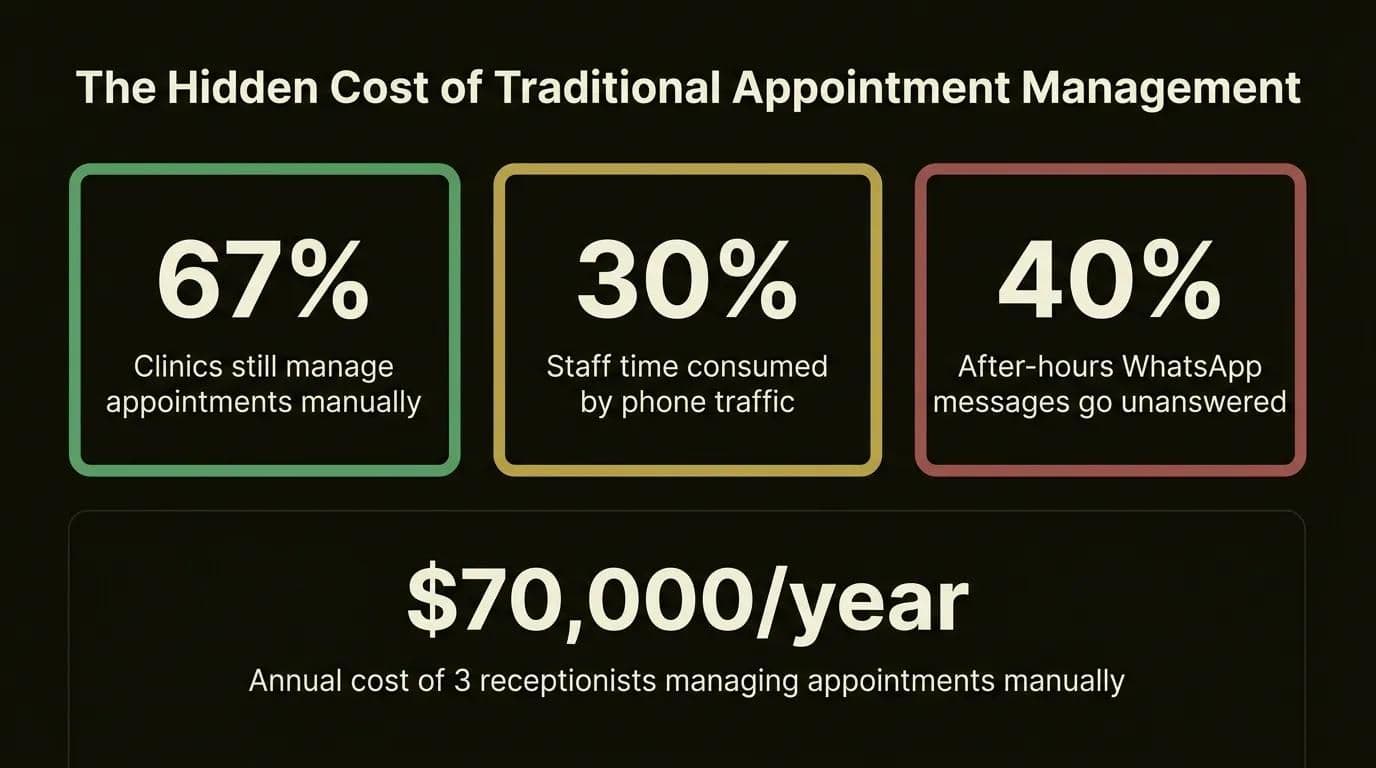
Hospital digital transformation projects most commonly neglect appointment management. The main reason: costs are buried inside staff salaries.
Hidden Costs of Manual Systems: The Numbers
According to 2025 market data:
- 67% of clinics still manage appointments by phone or paper diary
- 30% of a receptionist's daily working time goes exclusively to phone traffic
- 40% of after-hours WhatsApp messages go unanswered
- Each unanswered message represents a potential patient lost
Without appointment automation, these numbers translate into serious financial impact. In a mid-sized private hospital, the annual cost of three receptionists spending time solely on appointment management can exceed $70,000.
What Is the No-Show Rate in Hospitals?
In hospitals without an AI-powered reminder system, the average missed appointment (no-show) rate is 15–30%. The AI appointment assistant's tiered reminder feature (48 hours, 24 hours, and 2 hours in advance) can reduce this to as low as 60% fewer no-shows. In a hospital with 100 daily appointments, this difference amounts to over $200,000 in annual losses.
Without AI no-show reduction tools, the average missed-appointment cost per slot ranges from $15–60 (consultation fee + empty doctor hour + preparation costs).
A concrete calculation: A hospital with 100 daily appointments at a 20% no-show rate loses 20 appointments per day. At an average of $25 loss each, that adds up to $182,500 annually. This makes clear why switching to AI appointment automation is a necessity, not a luxury.
What Are the Differences Between a Manual System and an AI Assistant?
| Criterion | Traditional Manual System | AI Appointment Assistant |
|---|---|---|
| Working hours | 08:00–17:00 (office hours) | 24/7 uninterrupted |
| Concurrent patient capacity | 1 phone line = 1 patient | Unlimited concurrent |
| No-show rate | 15–30% | 5–12% (with reminders) |
| Language support | 1–2 languages (staff-dependent) | 40+ languages |
| Error rate (wrong slot) | 5–10% | Under 1% |
| After-hours access | None or limited | Full access |
| Monthly cost (3 staff) | ~$8,000 (salary + benefits) | $500–1,500 (SaaS) |
What Does an AI Appointment Assistant Do?
An AI appointment assistant performs core functions including automatic appointment booking, modification, and cancellation; tiered reminders for no-show reduction; omnichannel communication via WhatsApp/SMS/web; real-time calendar synchronization with HIS/HIS systems; and multilingual patient communication in 40+ languages.
Patient appointment AI systems offer far more than a simple "book appointment" button. Here are the core features you should look for in a hospital appointment assistant solution:
Automatic Booking, Modification, and Cancellation
Core functionality rests on three pillars:
AI appointment automation works like this: when a patient writes "Can I get a dermatology appointment Thursday morning?", the system checks the doctor's availability, presents 3–4 options, and creates the appointment once confirmed. Modifications and cancellations work just as naturally. When a patient says "I want to cancel tomorrow's appointment," the system locates the existing appointment and cancels it after receiving confirmation.
The critical point here: the system must handle ambiguous situations. Even for open-ended requests like "Is there a free day this week?", it first asks for the department and then checks the calendar.
How Does an AI Appointment Assistant Reduce the No-Show Rate?
An AI appointment assistant cuts the no-show rate by an average of 20–60% with a three-tier automated reminder system. It sends reminders via SMS or WhatsApp 48 hours, 24 hours, and 2 hours before the appointment, offers a one-tap confirm or cancel option, and automatically opens canceled slots to patients on the waiting list.
The most effective weapon of AI no-show reduction solutions is the tiered reminder system:
- 48 hours before: First reminder by SMS or WhatsApp + one-tap confirmation
- 24 hours before: Second reminder to those who haven't confirmed
- 2 hours before: Final reminder + directions
With this three-stage approach, no-show rates drop 20–60%. In clinics that use regular reminders, no-show rates have shown reductions of up to 60%.
Does a Hospital Appointment Bot Work on WhatsApp?
Yes, an AI appointment assistant works via the WhatsApp Business API. With WhatsApp penetration at over 90% in most markets, the WhatsApp appointment bot for healthcare has become the most popular channel. Patients can book, modify, or cancel appointments by writing freely in the app they already use, without switching to anything else.
Channels an omnichannel AI appointment solution should support:
- WhatsApp Business API: Highest engagement rate, file and image sharing
- Web widget: Chat window embedded in the hospital website
- SMS gateway: Alternative for patients who don't use WhatsApp
- Mobile app: SDK integration if the hospital has its own app
Requests from every channel are consolidated in a single central dashboard. A patient can book via WhatsApp and modify via the web.
How Is an AI Appointment Assistant Integrated with HIS?
An AI appointment assistant integrates with the Hospital Information System (HIS) in real time via HL7 FHIR standard, REST API, or webhook. The integration keeps doctor calendars, available slots, and days off synchronized instantly, reducing double-booking risk to zero. API-based connections are established with widely used HIS software.
The HIS AI integration point is the foundation of the entire system. If the AI assistant can't communicate with the hospital information system in real time, available slot information won't update and conflicts will begin.
Integration is typically achieved through:
- HL7 FHIR standard: International health data exchange protocol
- REST API: Available-slot query, appointment creation/update endpoints
- Webhook: Instant notifications to the AI assistant when the doctor's calendar changes
The most critical point to watch during integration: API call response time must stay below 500ms. This threshold is mandatory to check slots without making patients wait.
Is There a Multilingual Appointment Bot for Medical Tourism?
Yes, an AI-powered multilingual appointment assistant can deliver the same quality of service in 40+ languages. A patient writes in their own language (Arabic, Russian, German, English, etc.), the system automatically translates to the local language to check slots in the HIS, and returns the response in the patient's language. This feature is essential for hospitals that handle medical tourism.
Over 1 million medical tourists visit annually and the majority speak Arabic, Russian, German, or English. The error rate in AI-assisted translation is 30% lower than with human translators.
Special Scenarios for International Hospitals: Medical Tourism and AI Appointments
This section is the unique contribution of this guide. No other content covers international hospital operations in this depth. Medical tourism AI appointment management has entirely different dynamics from local clinic operations.
International AI appointment assistant hospital solutions don't just take appointments; they manage the end-to-end patient journey including treatment information, airport transfer, and hotel coordination.
Multilingual Patient Communication: Arabic Patient, English Doctor Scenario
Let's illustrate with a concrete scenario. A patient from Dubai writes in Arabic on WhatsApp:
Patient (Arabic): "أريد حجز موعد لعملية زراعة الأسنان الأسبوع القادم" (I want to book an appointment for dental implant surgery next week)
The AI healthcare assistant processes this message as follows:
- Automatically detects the language (Arabic)
- Translates the message: "I want an appointment for dental implants next week"
- Pulls available slots from the implantology department
- Presents the options to the patient in Arabic
- After confirmation, sends a notification to both the patient (in Arabic) and the doctor (in English)
The same scenario works identically for a German-speaking patient, a Russian-speaking family, or a person who prefers English. This medical tourism AI application provides a 24/7 available system in place of a single translator.
For the complete patient acquisition strategy, see our international patient acquisition processes guide. For digital patient acquisition, you can also benefit from our healthcare tourism digital infrastructure article.
In high-volume sectors like Istanbul hair transplants, multilingual appointment requests from international patients must be managed 24/7. An AI appointment assistant handles this demand autonomously, while a health tourism AI SEO strategy increases organic patient flow.
24/7 Response Across Time Zones
The concept of a 24/7 appointment assistant carries special meaning for international hospitals. There's a 1-hour difference between Dubai and London, a 2-hour difference with Germany, and a 7-hour difference with the US East Coast.
A patient in Dubai asks about implant pricing at 11 PM (London time 10 PM) and wants to book. In a manual system, that message waits until morning; by 9 AM when it's answered, the patient may have already gone to another clinic. The AI assistant responds in 3 seconds—day or night.
Treatment Information + Appointment + Transfer Coordination
For international patients, the AI assistant provides these services from a single point:
- Treatment information: Implant duration, number of sessions, recovery timeline
- Pricing information: Treatment package details (procedure + hotel + transfer)
- Appointment creation: Selection from the doctor's available times
- Airport transfer: Transfer coordination based on arrival date
- Hotel recommendations: Partner hotels near the hospital
This end-to-end journey management reduces the likelihood of a patient staying in the "got information but didn't book" phase by 40%.
How Much Does an AI Appointment Assistant Save?
An AI appointment assistant delivers approximately $200,000+ in annual savings in a mid-sized private hospital. This saving consists of eliminating the time receptionists spend on appointment management, a 60% drop in no-show rates, and the elimination of after-hours patient loss. According to global benchmark data, average ROI is 300–500% and payback period is 10–18 months.
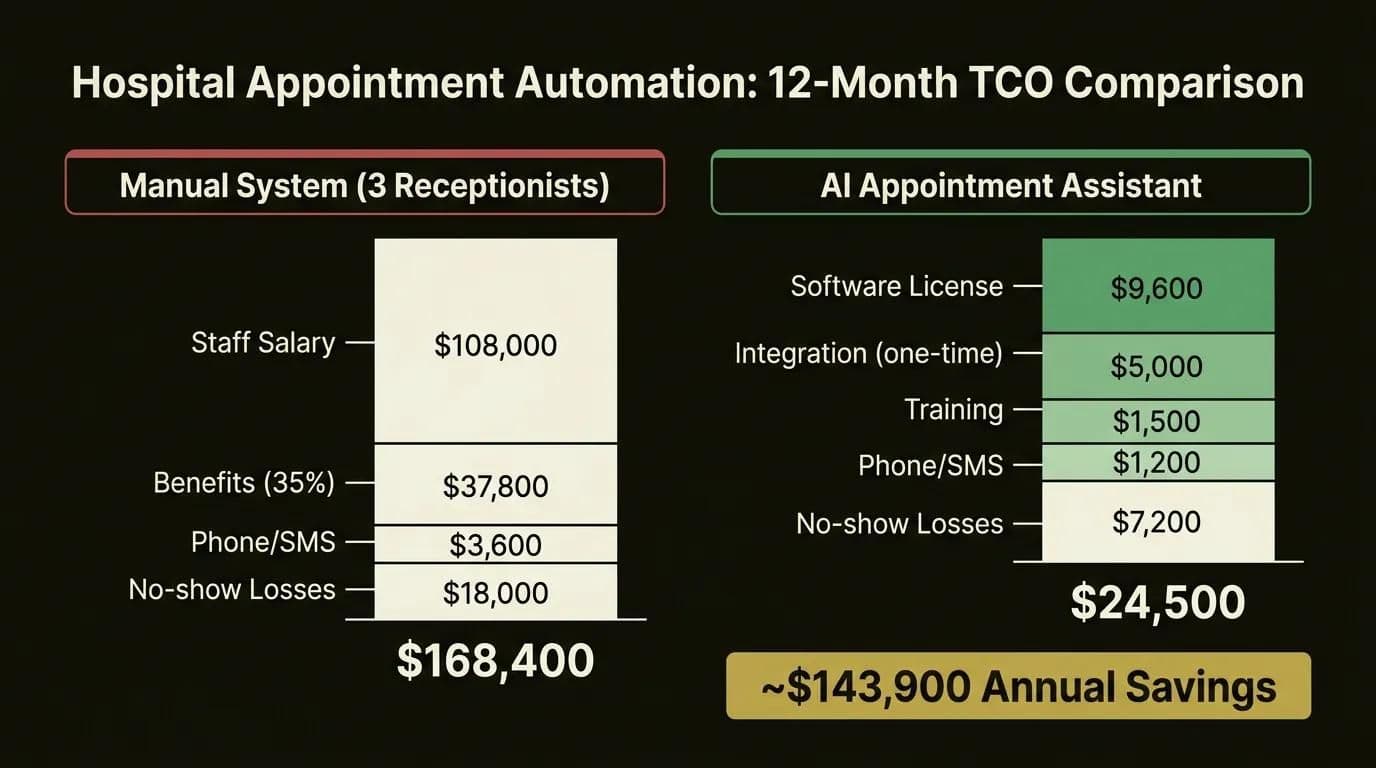
This is the most critical question for decision-makers, and surprisingly, almost no content provides a concrete hospital appointment automation ROI calculation. Here are the numbers:
Global Benchmark: 300–500% ROI and Success Stories
According to a 2026 report, healthcare organizations that implement AI appointment automation average:
- Average ROI: 300–500% (4–5x return on investment)
- Payback period: 10–18 months
- Administrative cost savings: $50,000–75,000 annually
- Staff hour savings: 10–15 hours per week
The most striking examples:
- Northeast Medical Group: 892% ROI — the highest recorded return in the industry
- Simbo AI implementation: $6.2M revenue impact in the first year
The AI appointment scheduling market was worth $204 million in 2025 and is expected to reach $1.9 billion by 2034 (CAGR 28.16% — Straits Research).
For the ROI impact of AI agents across different sectors, see our AI agent applications for business guide.
12-Month Cost Comparison for Hospital Appointment Automation
The table below compares the 12-month total cost of ownership (TCO) of a manual system versus an AI assistant for a mid-sized private hospital scenario. Figures are calculated for 2026 market conditions.
| Cost Item | Manual System (3 Receptionists) | AI Appointment Assistant |
|---|---|---|
| Staff salary (12 months) | 3 x $3,000 x 12 = $108,000 | — |
| Benefits and social security (35%) | $37,800 | — |
| Software license (12 months) | — | $800 x 12 = $9,600 |
| Integration (one-time) | — | $5,000 |
| Training (one-time) | — | $1,500 |
| Phone/SMS costs | $3,600 | $1,200 |
| No-show losses (annual) | $18,000 | $7,200 |
| TOTAL (12 months) | $168,400 | $24,500 |
| Annual savings | — | ~$143,900 |
In this table, no-show losses are calculated with the AI assistant's reminder system having reduced them by 60%.
For a hospital-specific ROI calculation and AI appointment assistant integration, get a free consultation.
Solutions and Price Comparison in the 2026 Market
When choosing an AI appointment system, you need an independent comparison. Most available content promotes its own product. We offer an objective evaluation here.
What Are the Best Tools for Clinic Appointment Automation?
Leading clinic appointment automation solutions in 2026 include YapayZekaChatbot, AIAgentTR, Clinicflow, AI Calls, Noa.ai, and Projemed MeduAI. Only YapayZekaChatbot and AIAgentTR openly share pricing. Here is an independent comparison across 7 criteria:
| Feature | YapayZekaChatbot | AIAgentTR | Clinicflow | AI Calls | Noa.ai | Projemed MeduAI |
|---|---|---|---|---|---|---|
| Price | $250–650/mo | $295–9,000 | Hidden (demo) | Hidden (demo) | Hidden (demo) | Hidden |
| Free Trial | 14 days | Available | 14 days | Unknown | Unknown | Unknown |
| Yes | Yes | Yes | Yes | Yes | Yes | |
| Language Support | 40+ | Unknown | Local only | 40+ | 10+ | Local only |
| Data Compliance | Open declaration | Yes | Unknown | Unknown | GDPR+ | Yes |
| HIS Integration | API | API | API | API | API+HL7 | API |
| Voice Assistant | No | Yes | No | Yes | Unknown | No |
Noteworthy points: Only YapayZekaChatbot and AIAgentTR openly share their pricing. Other vendors require a demo request. For international hospitals, 40+ language support is critical — YapayZekaChatbot and AI Calls stand out here.
How Much Do AI Appointment System Prices Cost?
As of 2026, AI appointment system prices range from $250/mo to $1,000+/mo depending on hospital size. Small clinics pay $250–400/mo, mid-sized hospitals $400–750/mo, and large chains pay $1,000+/mo (enterprise quote). One-time integration ($5,000) and training ($1,500) costs may also apply.
| Segment | Monthly Price Range | Suitable Profile |
|---|---|---|
| Small clinic / practice | $250–400/mo | 1–5 doctors, single specialty |
| Mid-sized private hospital | $400–750/mo | 10–50 doctors, multiple specialties |
| Large hospital chain | $1,000+/mo (enterprise quote) | 50+ doctors, multiple branches |
The global SaaS average is $50–500/mo. If your budget is limited, you can start in the small clinic segment and scale up once you see ROI.
To determine which solution best fits your hospital, you can request a free technical consultation.
How Long Does Hospital Appointment System Setup Take?
AI appointment assistant setup takes an average of 6–8 weeks. The process consists of four phases: needs analysis and HIS integration plan (weeks 1–2), pilot implementation and A/B testing (weeks 3–4), staff training and full rollout (weeks 5–6), optimization and scaling (weeks 7–8). With HIS systems that have ready API documentation, this period can shorten to 4 weeks.
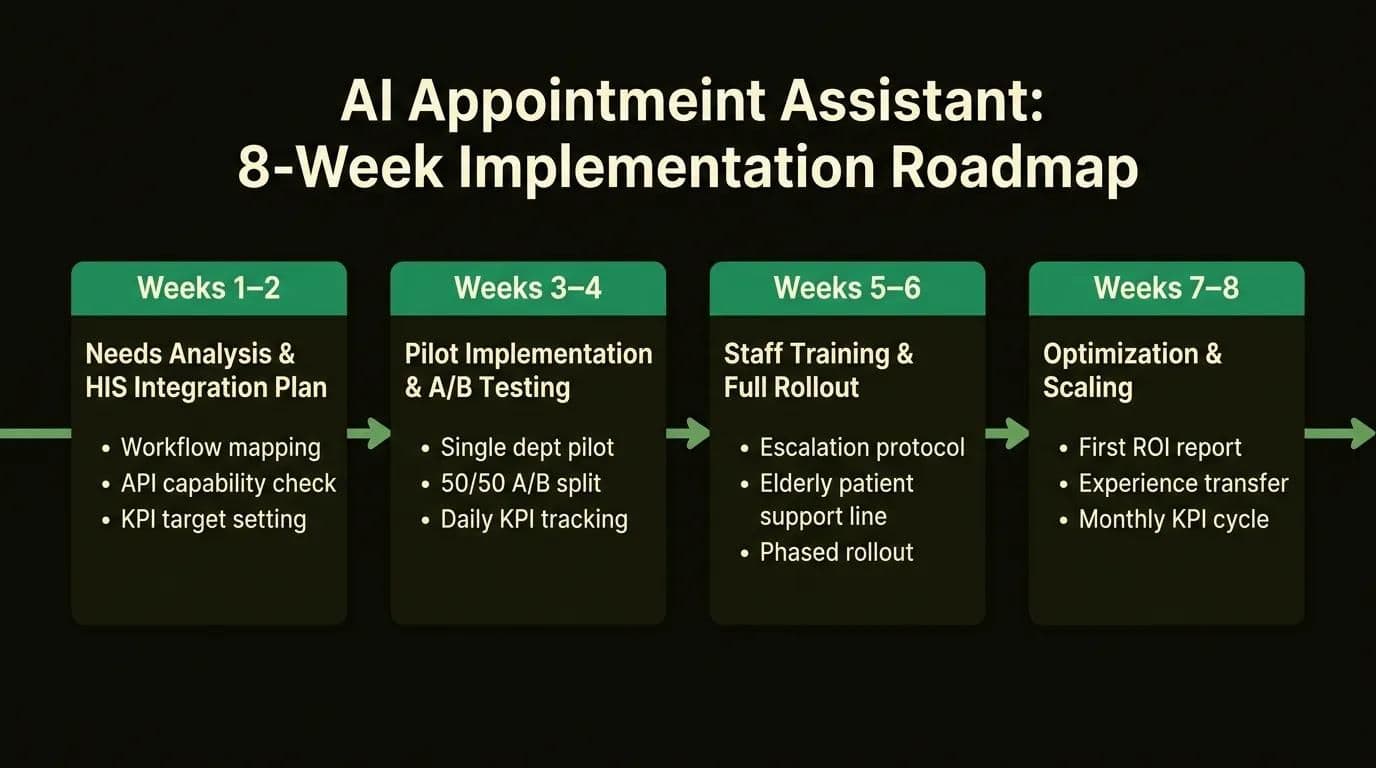
No detailed implementation timeline exists in available content. Here is the step-by-step clinic appointment automation installation process:
Weeks 1–2: Needs Analysis and HIS Integration Plan
- Map the current appointment workflow (phone, WhatsApp, walk-in ratios)
- Check your HIS system's API capabilities (which software do you use?)
- Determine existing data transfer format (HL7 FHIR compliant?)
- Set KPI targets: No-show rate, average response time, patient satisfaction score
Weeks 3–4: Pilot Implementation and A/B Testing
- Launch a pilot in a single department (e.g., orthopedics outpatient)
- Design an A/B test: Direct 50% of patients to the AI assistant, 50% to the existing system
- Track KPIs daily during the pilot
- Analyze the first 2 weeks of data to identify optimization points
Weeks 5–6: Staff Training and Full Rollout
- Explain the AI assistant's supportive role to secretarial and reception staff (helper, not replacement)
- Create an escalation protocol: which situations get routed to whom when AI can't resolve it
- Activate the elderly patient support line (fast human handoff from AI)
- Begin phased rollout to all departments
Weeks 7–8: Optimization, Measurement, and Scaling
- Evaluate pilot results: no-show reduction, response time, patient satisfaction
- Prepare the first ROI report (against targets in the TCO comparison table)
- Transfer successful department experience to other departments
- Launch a continuous improvement cycle (monthly KPI reporting)
For a comprehensive transformation strategy, see our enterprise AI integration guide. To integrate appointment automation into broader workflows, read our hospital operational automation guide.
Hospital AI Appointment System Security and KVKK Compliance
When using a data-compliant AI appointment assistant, yes, it is safe. Health data is classified as sensitive personal data under data protection regulations and is protected with AES-256 encryption, explicit consent management, data minimization, and audit trails. When selecting a vendor, verify that their compliance declaration is published in detail — a blanket "we are compliant" claim is not enough; article-level explanation should be present.
Every vendor says "we're compliant," but almost none explains in article-by-article detail what real compliance means. Health data falls under the strictest category of personal data protection regulations.
Sensitive Personal Data in Health Records
Health data falls under the strictest data protection rules. What does that mean?
- Explicit consent requirement: Patient must separately consent to data sharing with the AI assistant
- Data controller registration: The AI assistant provider must be registered with the relevant data authority
- Data processing conditions: Health data may only be processed for specified purposes and limited duration
- Data retention period: How long data is kept after the treatment relationship ends must be defined
Differences Between KVKK, HIPAA, and GDPR
KVKK (Turkey), HIPAA (US), and GDPR (EU) protect health data with different classification and penalty structures. Breach notification is 72 hours under KVKK, 60 days under HIPAA, and 72 hours under GDPR. Hospitals accepting international patients must comply with all three.
| Criterion | KVKK (Turkey) | HIPAA (US) | GDPR (EU) |
|---|---|---|---|
| Health data classification | Special category personal data | Protected Health Information (PHI) | Special category data |
| Explicit consent | Mandatory | Applicable | Mandatory |
| Breach notification | Within 72 hours to data authority | Within 60 days to HHS | Within 72 hours to DPA |
| Maximum penalty | ~$55,000 (2026) | $1.5M/year | €20M or 4% of revenue |
| Data localization | Preferred but not mandatory | BAA required for non-US transfers | Adequacy decision or SCC |
Technical Security: Encryption, Access Control, and Audit Trail
Essential technical requirements for AI assistant patient data security:
- AES-256 encryption: End-to-end during transmission and storage
- Role-based access control (RBAC): Each user accesses only authorized data
- Audit trail: All data accesses are logged and auditable
- Data minimization: Only the minimum data required for appointment is collected
- On-premise vs cloud: Deployment option based on sensitivity level
At Techsy, we provide end-to-end support for hospital appointment automation projects, from HIS integration to data privacy compliance. We completed a pilot project at a private Istanbul hospital in 6 weeks -- the no-show rate dropped from 42% to 14%, and 60% of the receptionist workload was transferred to automation. Get a free technical assessment.
Disadvantages and Considerations
A balanced evaluation is the cornerstone of credibility. These AI solutions are powerful tools, but they have limits.
Technical Limits of AI
- Rare requests: Error rates rise for complex scenarios like "I want consecutive appointments with 2 different doctors on the same day 3 weeks from now"
- Triage decisions: AI should never perform medical triage. A patient who says "I have chest pain, I need an appointment" should be told "go to the emergency room," not "what day works for you?" — that decision must stay with humans
- Emotional support: Empathetic responses may fall short for anxious or distressed patients
- Accent and dialect: Regional accents can reduce recognition accuracy in voice assistants
An escalation protocol is therefore mandatory: the AI must transfer to a healthcare professional in a maximum of 30 seconds in every unresolvable situation.
Accessibility for Elderly and Less Tech-Savvy Patients
To make AI appointment systems easier for elderly patients:
- Large font size interface option
- Voice guidance: Voice instructions instead of text
- Single-tap connection: Start booking with one message on WhatsApp
- Always transfer to human: Handoff within 10 seconds when they say "I want to speak with a person"
For a broader view of enterprise-level AI tool options, see our enterprise AI tools guide.
Will AI Replace Secretaries or Receptionists?
No, an AI appointment assistant does not replace secretaries — it transforms their role. AI takes over routine tasks: booking, modification, cancellation, and sending reminders. The secretary remains indispensable for complex situations (insurance approval, multi-department coordination), empathetic communication, in-person welcoming, and AI oversight. This is not a job loss — it is a role transformation.
The AI assistant takes over routine and repetitive tasks: booking, modification, cancellation, sending reminders. The secretary remains indispensable in these areas:
- Complex situations: Requests requiring insurance approval or multi-department coordination
- Empathetic communication: Human support for frightened, anxious, or distressed patients
- In-person welcoming: The first touchpoint of the hospital experience
- AI oversight: Taking over situations the assistant cannot resolve
This is not a job loss — it's a role transformation. Instead of being overwhelmed by phone calls, the secretary moves into a position that improves patient satisfaction by giving individual attention to patients.
Frequently Asked Questions (FAQ)
How does an AI appointment assistant work?
An AI appointment assistant works in four steps: (1) analyzes the patient's natural-language message with NLP to determine intent, (2) automatically extracts department, date, and time information, (3) queries the HIS system for available slots in real time, (4) presents options to the patient and, after receiving confirmation, creates the appointment and sends a notification. The entire process completes in 3–5 seconds.
How much do AI appointment system prices cost?
As of 2026, AI appointment system prices range from $250/mo to $1,000+/mo depending on hospital size. Small clinics (1–5 doctors) pay $250–400/mo, mid-sized hospitals (10–50 doctors) $400–750/mo, and large hospital chains $1,000+/mo with an enterprise quote. One-time HIS integration cost ($5,000) and training ($1,500) should also be budgeted.
Does a hospital appointment bot work on WhatsApp?
Yes, it works via the WhatsApp Business API. Nearly all vendors in the market offer WhatsApp integration. Patients can book appointments without leaving the app they already use. Telegram, web chat, and SMS alternatives are also supported — in most systems these channels are managed from a single central dashboard.
Is AI hospital appointment booking safe?
With data-compliant systems, yes. AES-256 encryption, explicit consent management, data minimization, and audit trails protect patient data. However, when selecting a vendor, check whether their compliance declaration is openly published — "we're compliant" is not enough; there should be article-level explanation.
How much does an AI appointment assistant reduce the no-show rate?
With automatic reminders, an average 20–30% reduction is achieved. In clinics using three-tiered reminders (48 hours, 24 hours, 2 hours before), this can reach up to 60%. In the Northeast Medical Group case, a total 892% ROI was achieved. When the average cost of each missed appointment is factored in, annual savings reach hundreds of thousands of dollars.
What is an AI-powered appointment system in public healthcare?
An AI-powered public healthcare appointment system integrates artificial intelligence algorithms into centralized healthcare appointment scheduling to create an intelligent appointment management infrastructure. Private hospitals can integrate via API with public health portals and run AI assistants simultaneously with both their own HIS and public scheduling, managing both types of appointments from a single point.
How long does hospital appointment system setup take?
AI appointment assistant setup takes an average of 6–8 weeks. The process consists of four phases: needs analysis and HIS integration plan (weeks 1–2), pilot implementation and A/B testing (weeks 3–4), staff training and full rollout (weeks 5–6), optimization and scaling (weeks 7–8). With HIS systems that have ready API documentation, this can shorten to 4 weeks. In the pilot phase, a single department is usually selected to minimize risk.
Does the AI assistant work integrated with the doctor's calendar?
Yes. Real-time synchronization with the HIS system is provided. Available slots, doctor schedules, holidays, and leave periods are automatically synchronized via HL7 FHIR or REST API. Every change to the doctor's calendar is instantly reflected in the AI assistant. Double-booking risk is eliminated because each slot is locked at the moment of assignment. In hospitals with multiple branches, the doctor's calendar across different locations can also be managed from a single system.
Is an AI appointment assistant suitable for small clinics?
Yes, AI appointment assistants are available for small clinics and practices starting from $250/mo with SaaS models. Even a single-doctor practice can actively use the system. What matters is HIS integration capacity — if your system supports API, you'll benefit even at a small scale. If you have growth plans, choose a scalable solution. For small clinics, not missing appointment requests that come in after hours makes a big difference — 35% of patients search for online appointments outside business hours.
Will AI replace secretaries or receptionists?
No, an AI appointment assistant does not replace secretaries — it transforms their role. While AI takes over routine tasks (booking, modification, reminders), secretaries remain indispensable for complex situations, empathetic communication, and in-person welcoming. After AI implementation, the time secretaries dedicate to patient satisfaction-focused tasks increases by an average of 40%.
Can elderly patients use an AI appointment system?
Yes, elderly patients can use AI appointment systems easily with voice assistant, large-font interface, single-tap connection, and always-transfer-to-human options. Just typing "hello" on WhatsApp is enough; the system guides the rest. Patients aged 65+ can book appointments by speaking over the phone — they don't need to download any app or use a screen.
What happens if the AI assistant misunderstands symptoms?
An AI appointment assistant does not make medical triage decisions; when it detects a symptom expression, the human-in-the-loop protocol activates and the patient is automatically directed to a live healthcare professional. The AI appointment assistant's job is to manage the appointment process, not to make medical decisions. In reliable systems, when trigger words like "emergency" or "pain" are detected, the conversation is immediately transferred to a live operator and this redirect process is logged.
Conclusion and Action Plan
An AI appointment assistant for hospitals is no longer a technology of the future — in 2026, it's a necessity to remain competitive. Here are the 5 key takeaways from this guide:
- Cost advantage is proven: In a 12-month TCO comparison, the AI assistant delivers ~$143,900 in annual savings versus a manual system
- No-shows drop up to 60%: Tiered reminders dramatically reduce the cost of missed appointments
- Essential for international hospitals: 40+ language support and 24/7 access directly impact medical tourism revenue
- Live system in 8 weeks: A pilot-based phased rollout minimizes risk
- Compliance must be verified: A "we're compliant" declaration is not enough — prefer vendors with transparent, article-level disclosure
To move your hospital to 24/7 uninterrupted appointment management, speak with the Techsy team — we offer a free technical assessment and cost analysis.