
Turkey's medical tourism market generated $3 billion in revenue in 2023 and hosted more than 1.5 million foreign patients. 60% of that came from Istanbul. Are you getting your share? International patient acquisition has moved firmly into digital channels; clinics with the right strategy generate a sustainable patient pipeline through organic search, while those without one burn through Google Ads budgets. This guide covers 8 digital channels, country-specific tactics, a channel-by-channel cost table, and a 90-day implementation roadmap you won't find anywhere else.
What Is International Patient Acquisition?
International patient acquisition refers to the process by which clinics and hospitals — under the umbrella of health tourism — use digital marketing, intermediary organisations, and international platforms to attract potential patients from foreign countries to Turkey for treatment. SEO, Google Ads, social media, and medical tourism platforms are the primary digital channels in this process.

Health Tourism 2026: Why International Patient Demand Exploded
Turkey's medical tourism market is targeting $6 billion in revenue by 2030, and 80% of patients research online before deciding on treatment. This puts digital channels at the top of the list for attracting foreign patients.
Istanbul is home to 25 JCI-accredited hospitals and accounts for the lion's share of Turkey's total medical tourism revenue.
Why now? Post-pandemic pent-up demand exploded, waiting times in Europe lengthened, and the depreciation of the Turkish lira made Turkey's price advantage even more pronounced. Among clinic patient acquisition methods, non-digital routes (trade fairs, embassy agreements) still exist but cannot scale. Digital can.
Let's look at the price advantage in concrete figures:
| Treatment | Turkey (EUR) | Germany/EU (EUR) | Savings |
|---|---|---|---|
| Dental implant (single) | 400–800 | 2,500–4,000 | 70–84% |
| Hair transplant | 1,500–3,500 | 5,000–15,000 | 70–77% |
| Cosmetic surgery | 2,000–8,000 | 5,000–25,000 | 60–68% |
This table isn't just a "sales argument" — it's the first thing potential patients search for on Google. The first step in international patient acquisition is presenting this price advantage clearly on your website. Clinics that don't do this lose patients at the very top of the conversion funnel.
Legal Framework and Prerequisites for Attracting International Patients
To bring patients from abroad, you must first obtain a health tourism authorisation certificate from the Ministry of Health, comply with advertising regulations, and apply for state incentive programmes. Starting digital marketing activities before completing these three legal prerequisites carries legal risk and forfeits the right to benefit from incentive support.
Most competitor content either skips this topic entirely or brushes past it in a sentence or two. Yet without a health tourism authorisation certificate, you cannot legally operate.
How to Obtain a Health Tourism Authorisation Certificate
To obtain a health tourism authorisation certificate, complete the following steps in order:
- Score a minimum of 85 in SKS inspection to document your competence
- Fill in the online application form at shgmturizmdb.saglik.gov.tr
- Prepare the required documents: healthcare facility licence, trade registry gazette, staff language certificates
- Pay the facility certificate submission fee: TRY 14,850 (2026)
- Await and pass the Ministry of Health on-site inspection
- Check certificate approval via the same portal
Intermediary organisations must additionally pay an application fee of TRY 2,500 and a certificate submission fee of TRY 26,005.
Operating promotional activities abroad without an authorisation certificate carries legal risk. Therefore, obtaining this certificate is the priority step before allocating a digital marketing budget.
Is Advertising Health Tourism Prohibited?
Advertising healthcare services to a domestic audience is prohibited in Turkey; however, outbound digital marketing activities targeting foreign audiences are permitted under certain conditions for organisations holding a health tourism authorisation certificate. Using Turkish in outreach ads targeting abroad is prohibited, and Turkey cannot be selected as the target audience.
Key points under the 2026 health tourism advertising regulation:
- Use of patient reviews and testimonials is restricted; compliance with the legal framework must be verified
- "Before and after" images may be shared in outbound-targeted posts with the patient's written consent
- Language, geographic targeting, and platform policies must all be considered together in outbound campaigns
- Guaranteed result promises and misleading statements are strictly prohibited
- Always review the current regulation text published in the Official Gazette
This complex framework makes working with a legal adviser essential when planning your health tourism digital marketing strategy.
What Are the Health Tourism Incentives for 2026?
The health tourism incentives in force in 2026, regulated by Presidential Decree No. 10962, provide authorised organisations with advertising, employment, patient transportation, and overseas office rental support. Support rates range from 25% to 70%, with annual caps between TRY 1.6 million and TRY 65 million.
Key support items:
- Advertising, promotion and marketing support — Including digital marketing expenses
- Patient travel support — Transportation costs for patients arriving from abroad
- Employment support — Gross salary for translators, call centre staff and marketing personnel
- Overseas office rental support — Rental costs for overseas offices/representations
- International organisation membership support — 25% rate, up to TRY 2.5 million per year
- Intermediary commission support — 50% rate, up to TRY 6 million per year
The incentive application process may seem complex, but it is manageable with the right guidance. The important thing is to factor these supports into your digital marketing budget planning and to run the application processes in parallel with your authorisation certificate application.
Channel 1 — Multilingual SEO: The Lowest-Cost Patient Source
What Is Health Tourism SEO and Why Does It Matter?
Health tourism SEO is a digital marketing strategy that enables clinics to optimise their websites in the language of target markets and rank organically at the top of high-intent queries like "dental implant Turkey cost" or "Haartransplantation Istanbul". The cost per patient drops to TRY 2,400–9,600 over 12 months, making it the most cost-effective channel.
Compared to Google Ads, initial results are delayed by 4–6 months; however, from month 12 onwards, the cost per patient drops dramatically. Multilingual SEO should form the cornerstone of your health tourism strategy.
What Architecture Should a Multilingual Website Use?
If you want to be visible to international patients, your website's multilingual infrastructure must be correctly set up. Three main architecture options and their advantages:
| Architecture | Example | SEO Advantage | Cost |
|---|---|---|---|
| Subdirectory | example.com/de/ | Authority consolidates on a single domain | Low |
| Subdomain | de.example.com | More technical control | Medium |
| ccTLD | example.de | Strongest geographic signal | High |
For most clinics, subdirectory architecture is the most pragmatic choice. Alongside this, correct hreflang tag implementation, page speed optimisation, mobile-first design, and Core Web Vitals compliance are non-negotiables for technical infrastructure. We cover the technical details of multilingual website infrastructure setup in a dedicated guide.
Country-Specific Keyword Research Examples
Separate keyword research is essential for each target market. A patient searching in German uses completely different terms than a patient searching in Arabic:
- German: "zahnimplantat türkei kosten", "haartransplantation istanbul erfahrungen"
- English: "dental implant Turkey cost", "hair transplant Istanbul reviews"
- Arabic: "تكلفة زراعة الأسنان في تركيا", "تجميل الأنف اسطنبول"
The query "istanbul hair transplant prices 2026" alone generates 12,000+ monthly searches, making it one of the highest-volume targets in health tourism SEO. From Germany, "haartransplantation istanbul kosten" (2,400/mo) and from the UK, "hair transplant istanbul price" (3,100/mo) drive international traffic directly to your clinic.
Use Ahrefs, SEMrush or Google Keyword Planner to run separate cluster work for each language. The "treatment + Turkey + cost" formula works in almost every language. Aim to build a structure of 10–15 pages per treatment area through a content cluster strategy.
E-E-A-T and International Trust Signals
Google evaluates health content in the YMYL (Your Money Your Life) category. This means you'll be subject to far stricter quality standards than an ordinary blog post. To strengthen E-E-A-T signals:
- Create doctor profile pages — Diplomas, experience, publications, specialisations
- Display JCI and ISO certificates prominently
- Publish real patient reviews and case studies
- Prepare multilingual trust pages — About us, team, accreditations
Without these signals, reaching top positions in organic rankings is practically impossible.
Scaling to 10 Languages with Autonomous AI SEO
Multilingual content is indispensable for international patient acquisition. But producing SEO content in 10 languages through traditional translation processes takes months and multiplies costs. When you allocate TRY 5,000–10,000 per language per month for translation, 10 languages means TRY 50,000–100,000 per month for translation alone.
AI-powered autonomous multilingual SEO systems radically shorten this process. Simultaneous content production in 10 languages, automated internal linking, and technical SEO maintenance can all be managed from a single platform. This approach delivers results at a fraction of agency cost and dramatically increases scalability.
It's possible to bring the TRY 200,000+ per month a traditional agency charges for 10 languages down to the TRY 15,000–40,000 range with autonomous AI SEO. That difference is game-changing for clinics with limited budgets. You can find full details on this topic in our health tourism SEO strategic guide.
Channel 2 — Attracting Patients via Health Tourism Google Ads
How Large Should a Health Tourism Google Ads Budget Be?
For health tourism Google Ads campaigns in 2026, a competitive starting budget is $3,000–5,000 USD per month. Cost per lead (CPL) varies from TRY 150–1,000 depending on treatment type. Unlike SEO, Google Ads delivers immediate traffic, capturing ready demand in high-intent queries like "dental implant Turkey".
However, cost management is critical; not planning your Ads budget properly for health tourism patient acquisition means burning money.
Country-Based Campaign Structure
Create separate campaigns for each target market. The ad copy, landing page, and negative keyword list for a Germany campaign should be completely different from a UK campaign. Without language-based segmentation, your budget leaks into the wrong clicks.
- Geographic targeting: Country or city level
- Language matching: Ad copy and landing page in the same language
- Negative keywords: Filter out informational queries (e.g. "free", "at home", "natural")
Budget Planning and CPL Expectations
Health tourism advertising budget planning requires realistic expectations. As of 2026, for a competitive market:
| Metric | Value |
|---|---|
| Monthly budget (competitive market) | $3,000–5,000 USD |
| Average CPL (cost per lead) | TRY 150–500 |
| High-value treatment CPL | Up to TRY 1,000 |
These figures vary by treatment type, target country, and competition intensity. Keep the budget flexible according to your international patient acquisition goals. In highly competitive areas like hair transplants, CPL may exceed the upper limit; in niche areas like dental tourism, it tends to stay at more reasonable levels.
Watch Out for Advertising Restrictions
Google's healthcare advertising policies are quite strict. Promises of "guaranteed results", misleading claims, and unapproved treatment methods lead to ad rejection. You need to manage platform policies alongside Turkey's legal restrictions.
For more on cost optimisation of health tourism Google Ads campaigns, see our digital marketing cost optimisation guide.
Channel 3 — Social Media and Meta Ads
Social media is a strong channel for health tourism digital marketing, both for organic reach and paid advertising. But you need to correctly understand social media's role in the patient journey: it's the "awareness" and "trust building" stage, not the direct conversion stage.
Instagram: First Contact Through Visual Power
Instagram is the most powerful social media channel for health tourism. The impact of visual content in your health tourism advertising strategy is undeniable. But be careful:
- "Before and after" images are subject to legal restrictions; opt for filter-free, authentic posts
- Reels format still outperforms for organic reach
- Location tags (Istanbul, Turkey) and language-specific hashtags boost discoverability
- Use Stories to show the clinic environment, team, and treatment process
TikTok and YouTube: Building Trust Through Video
Video content works as a trust-building tool as much as a health tourism ad. Real patient experience videos, treatment process narratives, and clinic tour videos accelerate potential patients' decision-making process.
Don't neglect SEO on YouTube: optimise video titles, descriptions, tags, and thumbnails to increase organic discoverability. Videos on YouTube appear in Google search results too for queries like "dental implant Turkey experience".
Facebook Groups and Community Marketing
Country-specific patient community groups are an extremely valuable source of organic traffic. Actively sharing useful information in Facebook groups like "Medical Tourism Turkey" or "Zahnbehandlung Türkei Erfahrungen" is one of the most effective ways to build trust without advertising directly.
Retargeting campaigns let you re-engage users who visited your website but didn't convert on social media.
LinkedIn B2B Marketing
A strategy absent from every competitor's content: B2B health tourism marketing via LinkedIn. Who's the target audience? Medical tourism intermediary organisations, international insurance companies, and corporate healthcare providers.
LinkedIn targets corporate partners, not individual patients. A single deal with an intermediary organisation can generate more revenue than months of individual patient acquisition efforts. Ignoring this channel is a major missed opportunity.
Channel 4 — Medical Tourism Platforms and Intermediary Organisations
How Do You Find Foreign Patients?
The fastest way to find foreign patients is to create a clinic profile on medical tourism platforms like Bookimed, WhatClinic, and Patients Beyond Borders. These platforms directly showcase your clinic to international patients; patient reviews, price transparency, and accreditation information are the key factors determining your ranking. Health tourism intermediary organisations charge a commission of 10–20% of the treatment fee in exchange for patient referrals.
Creating Profiles on Bookimed, WhatClinic, Patients Beyond Borders
Each platform has its own dynamics:
- Bookimed: Wide geographic coverage, high patient demand; profile detail and review count are ranking factors
- WhatClinic: UK and Europe-heavy patient base; price transparency matters
- Patients Beyond Borders: Premium audience; accreditation and certificate emphasis is critical
Optimise your profile: add professional photos, current prices, real patient reviews, and detailed service descriptions. Pay attention to review management; responding professionally to negative reviews builds credibility.
Working with Intermediary Organisations: Commission Structure
Intermediary organisations typically charge 10–20% of the treatment fee as commission. Some also apply a fixed monthly fee model. Criteria to consider when choosing an intermediary:
- Which markets are they strong in? (Germany, Gulf, UK, Russia)
- Annual number of patients referred
- Existing clinic references
- Contract terms and special requirements
Your Own Network vs. Intermediary Dependency
Long-term strategy means building your own digital network. In the short term, intermediaries deliver quick results but continuous commission payments erode profitability. The ideal approach: start with intermediaries, and reduce dependency as your own organic channels strengthen.
| Criterion | Own Digital Network | Intermediary Organisation |
|---|---|---|
| Start-up cost | High | Low |
| Long-term cost | Low | High (ongoing commission) |
| Control | Full | Limited |
| Brand awareness | Direct | Indirect |
| Scalability | High | Dependent on intermediary capacity |
| Data ownership | Full | Restricted |
Channel 5 — Content Marketing: Winning Patient Trust
Content is the backbone of any medical tourism marketing strategy. Across all international patient acquisition channels, SEO builds technical infrastructure and Google Ads delivers instant traffic; but what wins patient trust is quality content.
Patient Stories and Video Testimonials
Real patient experience videos significantly increase conversion rates. But pay attention to legal restrictions: patient consent must be obtained in writing, and filters or misleading edits must not be used in visual content. Publish videos both on your website and on YouTube for dual-channel reach.
Language and cultural fit matter. A story from a German-speaking patient will be far more effective in the German market; an Arabic-speaking patient's story will resonate more in the Gulf market.
Treatment Comparison Content
Comparison content like "Dental implants in Turkey vs Germany?" attracts both SEO traffic and accelerates the patient's decision-making process. Be objective in this content; while highlighting Turkey's advantages, honestly acknowledge the disadvantages too (long journey, language barrier, etc.). Readers interpret this as a credibility signal.
Driving Organic Traffic with Blog Posts and FAQ Pages
Create long-tail keyword-targeted blog content for each treatment area. Queries like "post hair transplant care", "dental implant recovery process", "rhinoplasty Istanbul experience" are low-competition but high-intent traffic sources. FAQ pages both improve user experience and offer the chance to earn rich snippets with FAQPage schema.
Conversion Optimisation: Turning Traffic into Patients
How to Increase Conversion Rates in Health Tourism?
Health tourism conversion optimisation covers the process of converting website visitors into leads, and leads into patients. Landing page optimisation, WhatsApp integration, video consultation, and all-inclusive package offerings are the four key levers in this process. Clinics that respond within 5 minutes can increase their conversion rate by up to 10 times.
Traffic alone doesn't generate revenue. There's a common bottleneck across all international patient acquisition channels: conversion.
Landing Page Optimisation and Form Design
Create separate landing pages for each target country and treatment type. Apply the minimum friction principle on forms: name, email, phone, and treatment interest are sufficient. Adding too many fields lowers conversion rates. Continuously optimise headings, CTA buttons, and form placement with A/B tests.
Instant Communication with WhatsApp Business
WhatsApp is the fastest communication channel for health tourism patients. Using the WhatsApp Business API, you can create automatic welcome messages, multilingual templates, and quick-reply buttons. WhatsApp is the preferred communication tool in Gulf countries and the German market in particular.
Video Consultation: The Weapon That 2–3x Your Conversion Rate
Offering a free online video consultation can increase conversion rates by 2–3 times. The patient sees the doctor face to face, gets a sense of the clinic's professionalism, and trust is built. Zoom, Google Meet, or clinic-specific solutions can be used. This step is critical especially for high-budget treatments (cosmetic surgery, implants).
What Is an All-Inclusive Health Tourism Package?
An all-inclusive health tourism package is a comprehensive service model that combines treatment, accommodation, airport transfer, guide services, and follow-up examination in a single price. This model eliminates the patient's worry about "what else will I have to pay" and shortens the decision time by 30–50%.
Transparent pricing is the most powerful trust signal in the international patient acquisition process. Display your prices in EUR or USD and keep your health tourism pricing page constantly updated.
CRM and AI Automation for Patient Management: HubSpot and Odoo Examples
Converting a lead into a patient is harder than acquiring the lead. The weakest link in your international patient acquisition strategy is usually this stage. Health tourism CRM software and automation tools close this gap.
What Health Tourism CRM Software Is Available?
Health tourism CRM software refers to sector-specific customer relationship management platforms used for managing foreign patient leads, tracking multilingual communication, and optimising the sales funnel. Key options in the Turkish market:
| CRM Software | Standout Feature | Target User |
|---|---|---|
| Planports | Patient tracking + sales funnel + social media integration | Clinics and hospitals |
| MedikalCRM | End-to-end health tourism process management | Healthcare organisations |
| SolaCRM | Multilingual automation and lead management | Health tourism companies |
| MetoCRM | Sector-specific business management software | Health tourism agencies |
| Bitrix24 | Wide integration and CRM infrastructure | All scales |
For example, a hair transplant clinic can use HubSpot CRM to segment leads by country and treatment type: a different nurture flow for those searching for Istanbul hair transplants, a different flow for dental treatment leads.
Key criteria when selecting a CRM: multilingual support, health tourism patient tracking system integration, GDPR compliance, WhatsApp and email integration, lead scoring, and reporting capacity.
Lead Qualification and Nurture Process
Not all leads are equal. Use the BANT model (Budget, Authority, Need, Timing) to qualify leads. Research shows clinics that respond within 5 minutes achieve a conversion rate 10 times higher than those responding an hour later. Aim to make first contact within 1–2 hours at the latest.
Keep unready leads warm with a nurture email sequence (3–5 emails): send treatment information, patient stories, pricing information, and finally an appointment offer in sequence.
GDPR compliance is mandatory when collecting data from EU citizens. Explicit consent, statement of data processing purpose, and the right to request data deletion must all be provided.
24/7 Patient Reception with AI Chatbot and Voice Agent
Here's the area you won't find in any competitor's content: health tourism artificial intelligence integration for patient reception automation. AI chatbots provide 24/7 multilingual patient reception on your website, while voice agents handle automatic responses and appointment booking on phone lines.
Think about it: a patient from Germany visiting your website at 10 PM (midnight Turkey time) can instantly receive information via a German-language chatbot and leave an appointment request. Every lead lost outside business hours is a patient going to a competitor.
See our dedicated guide for full details on AI-powered patient appointment automation. Our AI tools for healthcare overview article will also be useful.
Are you planning a multilingual AI chatbot or voice agent integration for your clinic? Get a free technical consultation.
Attracting Patients from Germany, UK and Gulf: Country-Based AI SEO Strategy
Target Countries for Health Tourism and Their Characteristics
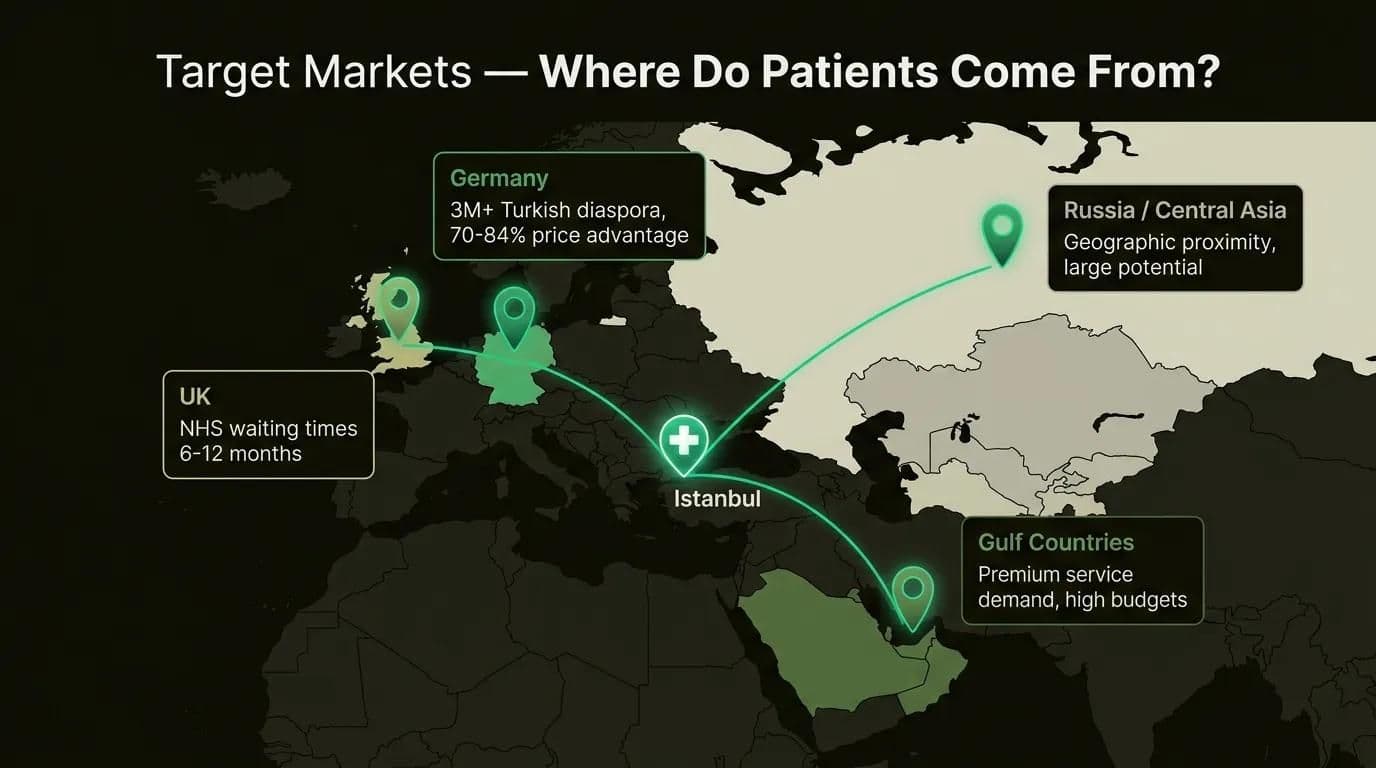
Every target market has its own dynamics. A one-size-fits-all "international marketing" approach doesn't work. You need to customise international patient acquisition methods by country.
| Target Market | Why It Matters | Primary Channel | Language |
|---|---|---|---|
| Germany | 3M+ Turkish diaspora, 70–84% price advantage | SEO + Google Ads | German |
| UK | NHS waiting times 6–12 months | Google Ads + Trustpilot | English |
| Gulf countries | Premium service demand, high budgets | Social media + intermediaries | Arabic |
| Russia/Central Asia | Geographic proximity, large potential | VKontakte + Telegram | Russian |
Germany: Price Advantage and Diaspora
Germany is the most strategic market for Turkish health tourism. The reasons:
- 3+ million Turkish diaspora — Low language barrier, high familiarity with Turkey
- High dental and cosmetic treatment demand — Price difference at 70–84%
- German content and SEO — Build authority on queries like "Zahnimplantat Türkei"
- Emphasis on doctor credibility — German patients care about diplomas, certificates, and experience details
Your German-language website, Google Ads campaigns, and social media content should be in native German, not professional translation. Cultural fit makes the difference.
UK Market: NHS Waiting Times Opportunity
In the UK, NHS (National Health Service) waiting times can stretch to 6–12 months. This creates a strong patient flow towards treatment abroad for private care. Turkey can capture this demand with its price advantage.
English-language landing pages, patient reviews on Trustpilot and Google Reviews, and GBP-based pricing will help you stand out in this market. Queries like "NHS waiting list alternative Turkey" carry high conversion potential.
Gulf Countries: Premium Service Expectations
Patients from Lebanon, Iraq, Saudi Arabia, and other Gulf countries expect VIP service. Transfer, accommodation, a dedicated interpreter, and a personalised care package are non-negotiable for this market.
- Arabic content and social media presence are essential
- Factor Ramadan, religious holidays, and holiday seasons into your campaign planning
- The budget profile of patients from Lebanon and Iraq differs from Saudi Arabia; calibrate the price/service balance accordingly
Russia and Central Asia: Overcoming the Language Barrier
The Russian-speaking patient population (Russia, Kazakhstan, Uzbekistan) holds enormous potential. The language barrier is the biggest obstacle; a Russian-language website, a Russian-speaking patient coordinator, and Russian-language social media content are the ways to overcome it.
Platforms like VKontakte and Telegram are the equivalent of Facebook and WhatsApp in this geography. You need to extend your marketing channels to these platforms too.
Health Tourism Digital Marketing Channel Cost Comparison
Which Digital Channel Brings How Many Patients?
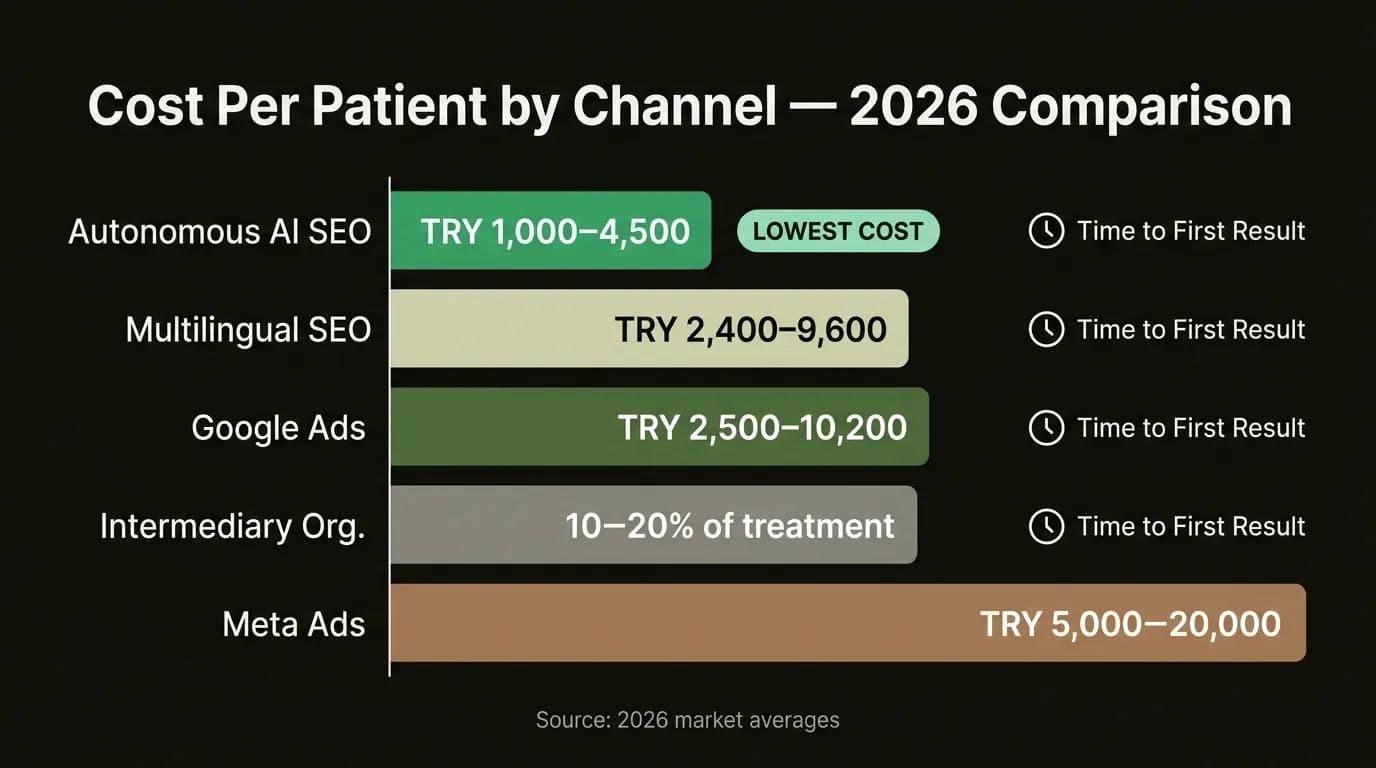
How much should you invest in each channel for international patient acquisition? The table below presents a channel-by-channel cost and return comparison based on 2026 market averages:
| Channel | Monthly Cost (TRY) | Time to First Result | Est. 12-Month Patients | Cost per Patient |
|---|---|---|---|---|
| Multilingual SEO | 15,000–40,000 | 4–6 months | 50–200 | TRY 2,400–9,600 |
| Google Ads | 50,000–85,000 | Immediate | 100–400 | TRY 2,500–10,200 |
| Meta Ads | 25,000–50,000 | 1–2 weeks | 30–120 | TRY 5,000–20,000 |
| Intermediary Org. | Commission-based | 1–3 months | 20–80 | 10–20% of treatment |
| Autonomous AI SEO | 5,000–15,000 | 3–5 months | 40–180 | TRY 1,000–4,500 |
Note: Values are derived from 2026 market averages and sector data. Actual results vary by clinic capacity, treatment type, and target market.
A 12-Month ROI Example
Let's think through a concrete scenario:
Profile: A dental clinic in Istanbul. Monthly budget: TRY 30,000 SEO + TRY 50,000 Google Ads.
- First 6 months: 15–25 leads per month from Google Ads, conversion rate 15% = 3–4 patients per month. SEO is still gaining momentum.
- 6–12 months: SEO organic traffic growing, adding 30–50 leads per month. Ads + SEO combined: 8–12 patients per month.
- End of month 12 total: Approximately 60–80 international patients. Average treatment revenue €2,000 = €120,000–160,000 revenue.
- Total 12-month investment: ~TRY 960,000 (SEO + Ads). ROI: 3–5x
This calculation is based on realistic assumptions. For high-value treatments like hair transplants or cosmetic surgery, ROI comes out significantly higher.
SEO or Google Ads — Which Is More Effective in Health Tourism?
SEO is the lowest-cost channel in the long run (TRY 2,400–9,600 per patient), while Google Ads delivers immediate results but traffic stops when the budget is cut. The most effective international patient acquisition strategy uses both channels together: capture ready demand with Ads in the short term, build sustainable growth with SEO in the medium to long term.
| Criterion | SEO | Google Ads | Intermediary | Autonomous AI SEO |
|---|---|---|---|---|
| Time to first result | 4–6 months | Immediate | 1–3 months | 3–5 months |
| Cost per patient | TRY 2,400–9,600 | TRY 2,500–10,200 | 10–20% of treatment | TRY 1,000–4,500 |
| When budget stops | Traffic continues | Traffic stops | Patient flow stops | Traffic continues |
| Scalability | High | Budget-dependent | Intermediary capacity | Very high |
Our detailed comparison on SEO agency selection criteria can help your decision-making process.
How to Get Started Attracting International Patients: 90-Day Roadmap
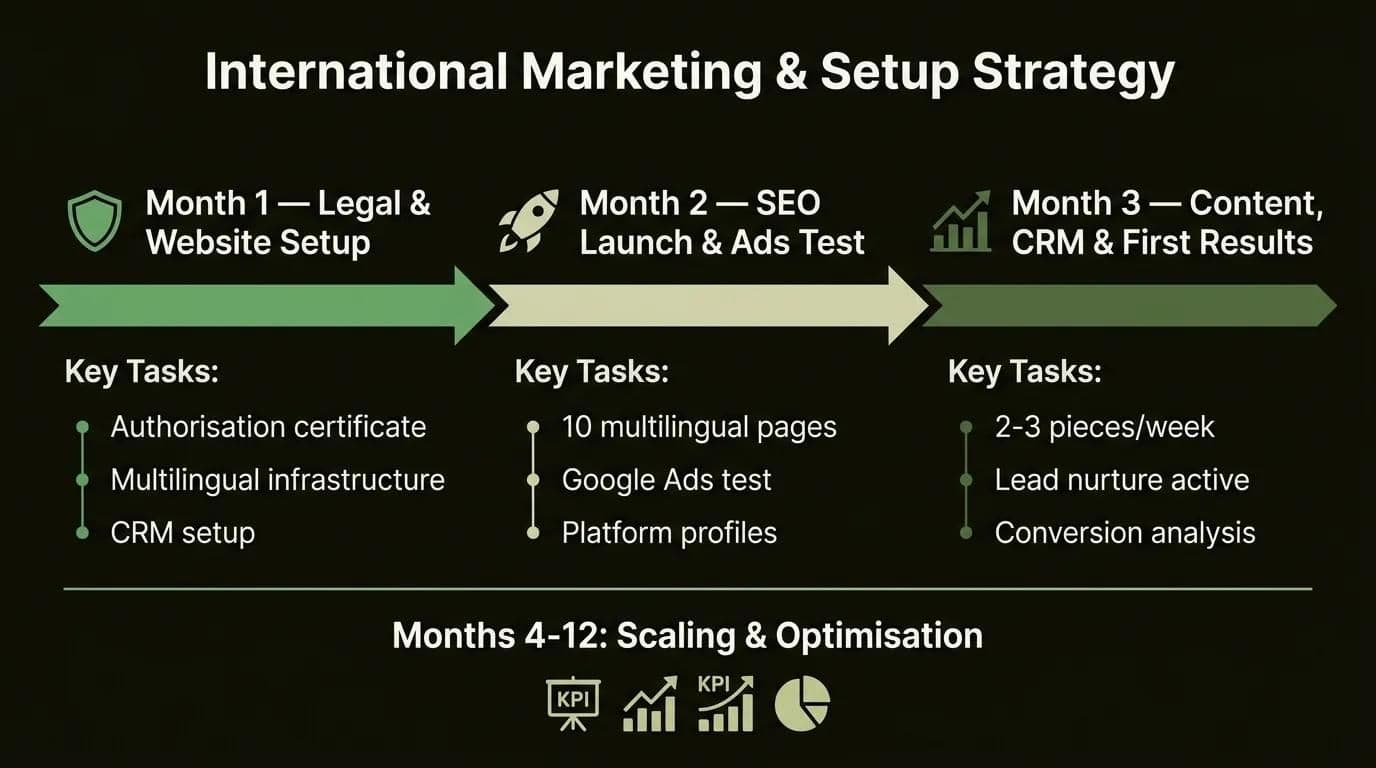
To start attracting international patients, month one should focus on legal infrastructure and website preparation, month two on SEO and Google Ads testing, and month three on accelerating content production and CRM integration. The 90-day roadmap below provides a concrete starting point.
Month 1 — Legal Infrastructure and Website Preparation
- Initiate your health tourism authorisation certificate application (shgmturizmdb.saglik.gov.tr)
- Set up your website's multilingual infrastructure (hreflang, language selector, subdirectory structure)
- Create and optimise your Google Business Profile
- Select a CRM and complete the setup (Planports, MedikalCRM or SolaCRM)
- Map out your content strategy and keyword map
- Initiate the incentive application process
Month 2 — SEO Launch and Google Ads Testing
- Publish your first 10 multilingual pieces of content (1–2 pages per treatment area in 2–3 languages)
- Launch a Google Ads test campaign: low budget, A/B testing, 2–3 country targets
- Set up social media profiles and begin executing the content plan
- Open medical tourism platform profiles (Bookimed, WhatClinic)
- Complete WhatsApp Business setup
Month 3 — Content Production, CRM Integration and First Results
- Increase content production speed: 2–3 pieces per week, in each language
- Activate the lead nurture process with CRM (automated email sequences)
- Google Ads optimisation: reduce CPL, add negative keywords, increase budget on successful campaigns
- Analyse the first conversion metrics: traffic source, CPL, conversion rate
- Set up and test the video consultation infrastructure
Months 4–12 — Scaling and Optimisation
- SEO content target: 50+ pages (total, across all languages)
- Shift budget to successful channels; scale down low-performing ones
- AI automation integration: chatbot, voice agent, automated appointments
- Country-based strategy expansion: from 2 initial markets to 4–5
- KPI tracking: CPL, ROAS, cost per patient, conversion rate, organic traffic growth
The Techsy Approach: Scaling Patient Acquisition with Autonomous AI
Most of the international patient acquisition strategies described in this guide require technical infrastructure, multilingual content production, and automation. At Techsy, we have specific experience in this area.
Our autonomous multilingual SEO infrastructure manages simultaneous content production in 10 languages, automated internal linking, and technical SEO maintenance from a single platform. Our health tourism artificial intelligence integrations include multilingual AI chatbot, voice agent, and appointment automation solutions.
At Techsy, we built the patient acquisition infrastructure for an Istanbul clinic across 6 countries. Result: monthly organic leads grew from 12 to 89, and cost per patient acquisition dropped by 72%.
Our approach is not about "replacing an agency" — it's about "doing what agencies can't". A traditional agency takes months to produce content in 10 languages and multiplies the budget; with autonomous AI, this process comes down to days and cost drops to a fraction.
We back this up not with promises, but with measurable results. We define a customised strategy, transparent reporting, and clear KPI targets for each clinic. When other solutions are more suitable, we say so openly; there are of course situations where an intermediary or Google Ads makes more sense.
Want to scale your health tourism digital strategy with AI? Get a free consultation.
Frequently Asked Questions (FAQ)
Is an authorisation certificate required to bring patients from abroad?
Yes, obtaining a health tourism authorisation certificate from the Ministry of Health is mandatory to bring patients from abroad. The application is made via shgmturizmdb.saglik.gov.tr, a minimum SKS score of 85 is required, and the certificate submission fee in 2026 is TRY 14,850. Conducting promotional activities abroad without an authorisation certificate carries legal risk and precludes access to government incentives.
Is advertising health tourism prohibited?
Health tourism advertising targeting a domestic audience is completely prohibited; however, organisations holding a health tourism authorisation certificate may place digital ads in languages other than Turkish, targeting only foreign audiences. "Before and after" images may be used with the patient's written consent; guaranteed result promises and misleading statements are strictly prohibited. Geographic targeting and language settings must be correctly configured in outbound-targeted campaigns. Always review the current regulation text in the Official Gazette.
Is SEO or Google Ads more effective in health tourism?
In health tourism, SEO is the lowest-cost channel in the long run (TRY 2,400–9,600 per patient), while Google Ads delivers immediate results but traffic stops when the budget is cut. The most effective strategy is to use both together: capture ready demand with Ads in the short term, build sustainable organic growth with SEO in the medium to long term. If your budget is limited, invest in SEO first.
How large should a health tourism advertising budget be?
Health tourism advertising budgets in 2026 can be estimated at $3,000–5,000 USD per month for Google Ads, TRY 15,000–40,000 for SEO, TRY 5,000–15,000 for autonomous AI SEO, and TRY 10,000–25,000 for social media advertising. Total budget should be adjusted based on clinic capacity, treatment type, and number of target markets. The most pragmatic approach is to start with a test budget for the first 3 months and scale based on conversion data.
Does working with a medical tourism agency make sense?
Medical tourism agencies provide quick patient flow in the short term, but 10–20% commission is paid on the treatment fee; for high-value treatments, this adds up to significant sums. Building your own digital network in the long term is both more cost-effective and directly builds your brand awareness. The ideal approach: start with intermediaries in the short term and gradually reduce intermediary dependency as organic channels like SEO and content marketing strengthen.
Which countries send the highest-quality patients?
The highest-potential markets for health tourism in Turkey are, in order: Germany (3 million Turkish diaspora and 70–84% price advantage), UK (6–12-month NHS waiting times), Gulf countries (premium service demand), and Russia/Central Asia (geographic proximity). You should prioritise based on your clinic's specialisation: Germany generally delivers higher conversion for dental treatment; Gulf countries for cosmetic surgery.
How quickly should leads be responded to?
The ideal response time for health tourism leads is 5 minutes or less; clinics responding within this timeframe achieve a conversion rate 5–10 times higher than those responding an hour later. First contact should be made within 1–2 hours at the latest. Having an AI chatbot provide 24/7 instant responses gives a major advantage in reaching this speed. Every lead lost outside business hours is a patient going to a competitor.
How long does content marketing take to produce results?
Health tourism content marketing (organic SEO) typically delivers measurable traffic growth within 4–6 months and reaches full momentum at 12 months. While Google Ads delivers traffic from day one, SEO content generates cumulative value supporting sustainable long-term growth. The ideal strategy: achieve short-term results with Ads while continuing to produce SEO content in parallel.
How is artificial intelligence used in health tourism to find patients?
Artificial intelligence is used in five key areas in health tourism:
- Multilingual SEO content production — Reduces the traditional translation timeline from months to days with simultaneous content creation in 10 languages
- AI chatbot — Provides 24/7 multilingual patient reception and information on your website
- Voice agent — Handles automatic responses and appointment booking on phone lines
- Lead qualification — Automatically scores and prioritises incoming enquiries
- Personalised follow-up — Creates patient-specific email and message sequences
What are the health tourism incentives?
The health tourism incentives in force in 2026 are regulated by Presidential Decree No. 10962. Key supports include: advertising and marketing support (including digital marketing), patient travel support, employment support, overseas office rental support, and intermediary commission support (50% rate, up to TRY 6 million per year). KOSGEB also provides additional support for clinics with SME status. Running the application process in parallel with your authorisation certificate application saves time and enables healthier budget planning.
How effective are all-inclusive packages in attracting patients?
All-inclusive health tourism packages shorten patients' decision time by 30–50% and directly eliminate the most common objection — "fear of hidden costs". Transparent package prices covering treatment, accommodation, airport transfer, guide services, and follow-up examination are a powerful trust signal for international patients. Displaying prices in EUR or USD makes it easier for international patients to compare.
How does GDPR affect patient data management?
GDPR compliance is mandatory when collecting health data from EU citizens. Key requirements include obtaining explicit consent, stating the purpose of data processing, providing the right to request data deletion, and ensuring the CRM software is GDPR-compliant. Personal health data collected during the health tourism process falls in the "sensitive data" category, requiring additional protection measures. Also pay attention to the differences between KVKK (Turkey's data protection law) and GDPR; you need to create a data management policy compliant with both regulations simultaneously.
You've explored international patient acquisition pathways — now it's time to build your strategy. Schedule a free consultation with the Techsy team.